

970x125
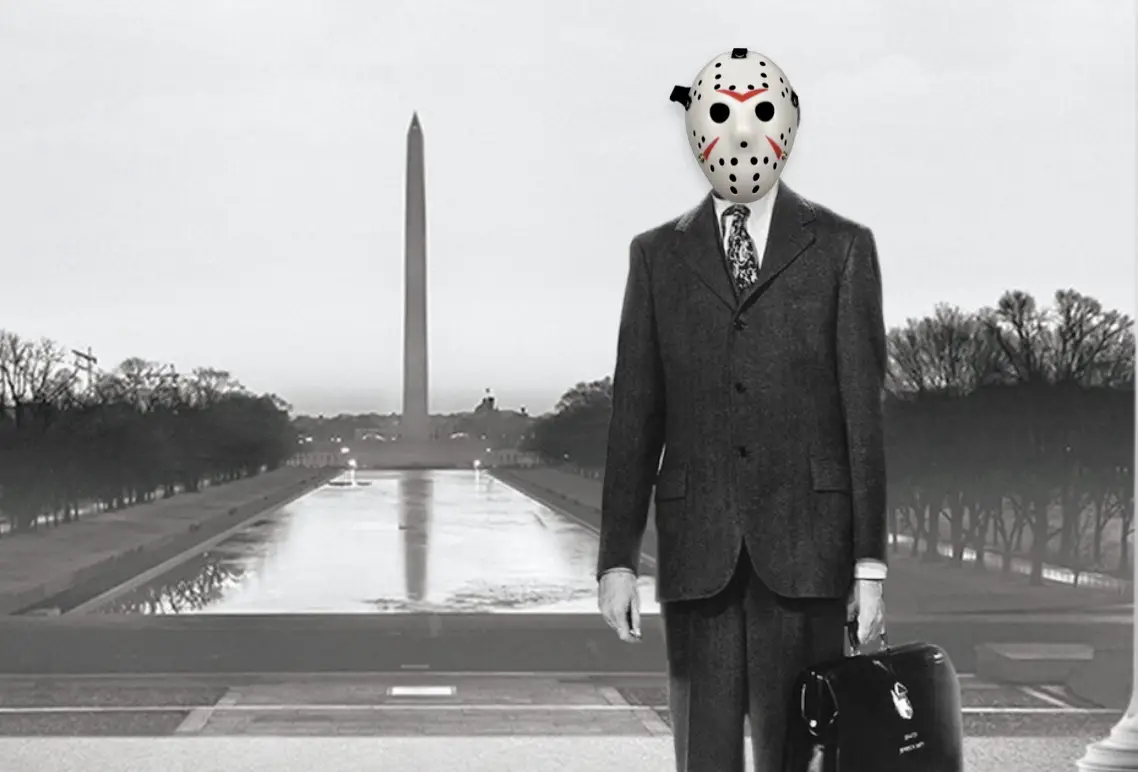
No, “Mr. Voorhees Goes To Washington” *isn’t* coming to theaters anytime soon … or is it?
Sorry kids, but horror movies have been political for 100 years and counting
Every now and then you’ll see somebody on social media proclaim they’re sick and tired of horror movies getting political. They wish filmmakers would default to the good old days, back when genre movies were devoid of social commentary and partisan rabble-rousing. There’s just one problem with that opinion: that time period never existed.
As long as films have been around they’ve been intrinsically political. And horror literature has been intrinsically political for centuries. The very genre is rooted in a reflection of the times; horror is literally about capitalizing on what people are afraid of and politics have always been one of the most terrifying things in the universe.
The online (lack of) discourse usually boils down to a pointless liberal versus conservative debate, as if they aren’t a million different political perspectives out there that can’t be easily classified as Democrat in nature or Republican in nature. One side will chide anything that runs contrary to their personal ideologies as “woke” or “degenerate” while the other side criticizes and condemns everything opposite their political convictions as “fascist” or “racist” or “misogynistic,” etc.
Now, we here at Wicked Horror aren’t going to tell you who’s “right or wrong” in these kinds of debates. Everybody’s entitled to their personal political perspectives and everybody’s entitled to advocate for their personal interests, even if they’re totally wrongheaded and disadvantageous for everybody else. But there’s a stark difference between believing in something in the abstract and actually doing something in reality. Politics stop being politics when they begin physically impacting people. And if you can’t see the intrinsic horror in that, you probably failed high school civics a couple of times.
The earliest feature length horror movies weren’t even called “horror” movies at the time. Films of the 1910s like The Student of Prague and The Avenging Conscience were basically morality plays where people who do underhanded and unscrupulous things are punished through some sort of cosmological fluke and/or ironic predicament. They were movies about greedy, lustful and vengeful people getting what’s coming to them — which, basically, is the same bedrock for every slasher movie we’ve gotten from 1978 onward. By the time we started getting horror films with obvious supernatural undercurrents in the 1920s, the bulk of the most famous and influential ones were all adaptations of classical literature and/or folk tales. Dracula, Frankenstein, The Phantom of the Opera, The Golem, Nosferatu, The Cabinet of Doctor Caligari, so on and so forth — they may have been movies with literal monsters in them, but all of them had a secondary, figurative monster in the societies they reflected. Dracula was LITERALLY about oligarchs preying on virgins, The Golem was LITERALLY about the persecution of Jews, Frankenstein was LITERALLY about the excesses of the Industrial Revolution and Nosferatu was essentially a metaphor for the fear of immigrants. All of the foundational German Expressionism films were bluntly about the horrors of World War I and the rising tides of what would eventually become Naziism — and frankly, I’m not sure how anything could be more “political” than that.
Keep in mind, these are movies that are more than 100 years old now. Their politics and social commentary is unmistakable and in each subsequent decade you can see horror movies paralleling the newfound fears and paranoia of their respective times. The fifties saw the rise of atomic monster creature features, the sixties was a decade of generational conflict (see A Bucket of Blood, Night of the Living Dead and Witchfinder General for three ultra-obvious examples) and the seventies were all about the dark side of the sexual revolution. The ultra-conservative ‘80s gave us the golden age of slasher flicks (where teenagers are punished for doing drugs, talking back to grown-ups and having premarital sex) while the despondently chic ‘90s gave us self-aware, humorous meta-horror movies like Scream, Dead Alive and virtually everything released by Troma that decade.
It’s not just that politics have a place in horror, it’s more the notion that horror IS politics. Name a successful, influential horror movie made over the last 50 years and I can almost certainly pinpoint a not so secret element of social commentary coursing through its celluloid veins.
Dawn of the Dead is about brainless consumerism. Child’s Play is about children’s advertising. Aliens is straight up a parable about the Vietnam War. Candyman is about racism and poverty in America’s inner cities. And Night of the Demons 2 is *obviously* about the ills of private schools and Catholic guilt — I mean, I don’t think anybody is going to argue to the contrary there.
I’m not sure why anybody would hold an impenetrable belief that “horror” is somehow the one art form and method of self-expression that should be totally immune from political influences, especially considering we’ve got a century of irrefutable evidence demonstrating just how innately political horror cinema has always been. It’s more an issue of people hating “political” horror movies when those specific politics are the antithesis of what they believe in. We’ve all seen conservatives bemoan Sinners and The Substance for representing “woke” ideals and we’ve all seen liberals bemoan I Spit on Your Grave and Savage Streets as “male gaze” rape apologia. The mere existence of some directors automatically draws ire from certain subsets of the horror fan community — as Eli Roth and Jordan Peele perfectly demonstrate. At this point, the actual talking point is practically “keep politics out of horror, just as long as they’re not my preferred brand of politics.”
Of course, it’s an unstructured, uncivil debate that will never end, because it’s not designed to end at any point, for any reason. It’s just another pointless exercise in raging against total strangers and a way for people on the internet to feel vindicated for doing absolutely nothing. No fandom is immune from this, and I suppose it’s just going to be part and parcel of the online horror community until the sun goes hyper-giant and evaporates all traces of humanity from planet earth.
Alas, there’s a deeper tragedy in all of this. Indeed, it’s a mild rephrasing of an old chestnut that illustrates the deeper problem we should all be more concerned about.
All I can say is we’ll take politics out of horror — right after you take the horror out of your politics.

