

970x125
Earlier this month (July, 2026), I attended a celebration of the 70th anniversary of the International Society for Psychological and Social Approaches to Psychosis, in Lausanne, Switzerland. The ISPS had been founded there, in 1956, by two young Swiss psychoanalysts, Gaetano Benedetti and Christian Muller, who were dissatisfied with reductionist, biological understandings and treatments of “schizophrenia.”
Today, ISPS has branches in more than 20 countries. Nearly 500 members and supporters came to Lausanne for our 24th international congress, entitled “Back to the Future; Inspired by Pioneers.”
Although I only joined in 2000, it seems I have been actively involved long enough to qualify as a pioneer, as I was invited to give the opening keynote address to the conference—a real honour.
In those 26 years of membership, including 10 years on the International Board and six as chair of the New Zealand branch, I have seen ISPS grow and change in leaps and bounds. I have seen us transform from a purely professional organisation, comprised almost exclusively of psychiatrists and psychoanalysts, to one that embraces experts by experience, and family members, and professionals from all disciplines. This makes us a rather “broad church.” We don’t always agree, for example, about the value of psychiatric diagnoses and medications. But we are united in the struggle to make talking therapies and other psychological and social approaches more accessible. It has not been an easy struggle, but we are slowly winning.
Other developments have included the start of the ISPS book series in 2003, which now extends to 35 books (including two editions of my own Models of Madness), and the launch of our research journal, Psychosis, in 2009. I have been its editor for 17 years.
In 2012, the international membership voted almost unanimously to remove the word “schizophrenia” from our name because it is an unscientific and stigmatising concept.
In recent years I have been rather less involved, having been pulled into work on antidepressant withdrawal and electroconvulsive therapy. I had missed the last few international congresses. So Lausanne felt a bit like a homecoming.
I had been asked to give my address on “The psycho-social causes of psychosis: Thirty years of research.” I did present a few of our studies, starting with the 1997 review that had led to my being invited to my first ISPS Congress in Stavanger, Norway in 2000.
But I got to the research part of my talk only after I had argued that we shouldn’t really need research to prove something as obvious as the fact that madness is caused by maddening things happening. Surveys of the public all over the world show that most people know that psychosis, depression, anxiety, etc., are caused by adverse life and circumstances. In fact, I have been teased over the years for seemingly having made a career out of just one idea: that bad things happen and they mess us up—an idea, moreover, that everyone knows already! Everybody, that is, except about half the members of one mental health profession—and the drug companies.
I suggested that probably every one of the several hundred people in the room had their own stories to tell that had taught them this obvious fact of life, and that it had made them interested in mental health and psychosis. I told some of the stories I have used with undergraduates for decades to normalise and to encourage self-reflection. I talked about how, when I had gotten cross about something as a 4-year-old, my Dad had explained to me, rather angrily, that “Anger is what causes war, my son, and I don’t ever want to see you angry again!” (Thanks Dad: To this day I sometimes feel guilty when I fail to bottle my anger and it seeps out on someone.) I couldn’t resist the urge to recite a poem, the only one I know by heart, the one by Philip Larkin that starts “They f*ck you up your Mum and Dad, they may not mean to but they do.”
In my dear old Dad’s defence, I explained that he had been a fighter pilot in the Second World War for three years, when life expectancy was seven weeks. Perhaps the craziest part of my tale, however, was when many years later my Dad explained to his son, now a young man, “I am sorry I have been such a distant father. You see, I repeatedly got really close to my buddies in the war but kept seeing them shot out of the sky, all the time wondering when it was going to be my turn. So, I didn’t really do feelings after that.” Or was the most mad part the moment when my Mum, who was listening, said, “I didn’t know that.”
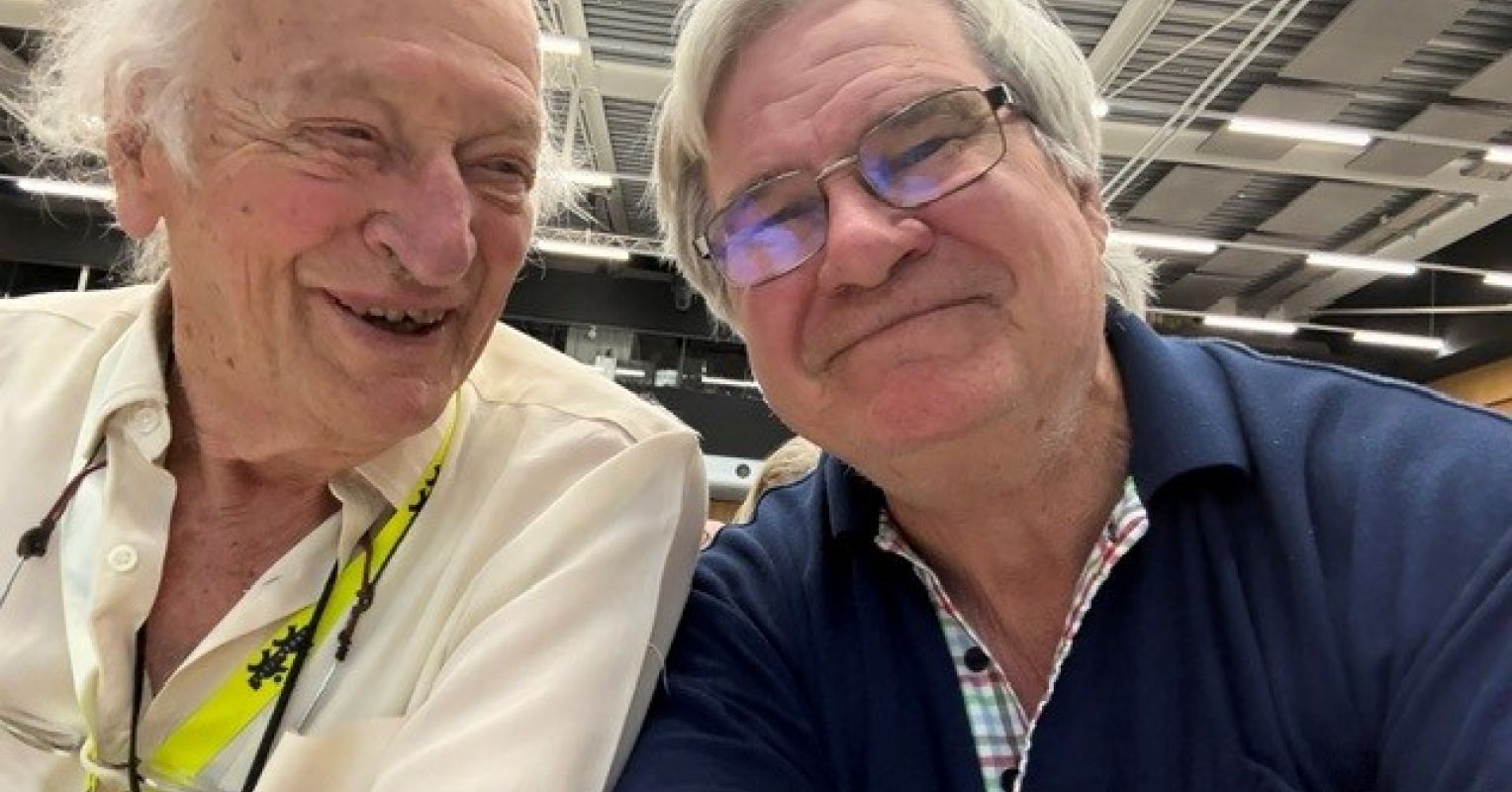
The highlights of the conference, for me, included being reminded by two giants in psychosis research, Luc Ciompi (still going strong at 97—see photo, with me, in Lausanne) and Courtenay Harding, about their 30-year follow-up studies showing the extreme variability in outcomes for people labelled “schizophrenic.” This is so important in countering the pessimistic, unscientific claims that there is a thing called “schizophrenia,” which is a permanent brain disease from which you can never recover. Millions of lives have been ruined by that unevidenced self-fulfilling prophecy.
Psychosis Essential Reads
Another highlight was hearing from psychiatrist Pesach Lichtenberg about the growth of Soteria Houses, psycho-social alternatives to hospitalisation in Israel.
The point of this post is to celebrate a wonderful organisation, and to encourage any of you interested in psychosis, whether expert-by-experience, family member, nurse, psychologist, psychotherapist, counsellor, psychiatrist, or none of the above, to join us. I will end this the way I end most of my talks for the past 30 years, including the one in Lausanne last week:
“It may well be a very hard struggle, but you sure meet the best people along the way.”

