

970x125
“I walked away from that cemetery with nothing,” my grandmother told me about the day she buried her husband. “I had a 7-year-old child by the hand and I had no job, no money, nothing. The neighbors had to take up a collection for me so I could buy groceries.” With an unlikely twinkle in her eye, she added, “and it was the happiest day of my life.”
That doesn’t speak well of my grandfather, I know. If it were the only story I’d ever heard about him, I would probably conclude that he was a difficult man. But it’s not the only story. In fact, family stories describe him variously as a villain, a hard-working immigrant trying to get by in a New York not so friendly to the Irish, or something in between. How could I know the truth?
The Power of Family Stories
Old family stories, repeated often (to the chagrin of many a grandchild), pass on not just memories but values. With every re-telling, the story can be heard differently, incorporated into the listener’s developing understanding of the characters. So what happens to those stories when a grandparent doesn’t live long enough to tell (and re-tell) his own stories? How do we come to understand our family’s values when we only get those stories secondhand?
Intermediaries can pass family stories along, but like the blind men and the elephant, they speak from their own viewpoint. That’s why my grandfather has been such a mystery to me—whose version of the elephant do I believe? Was he a lousy drunk, a vet with PTSD, or both—or something else entirely?
I’d be inclined to cut my grandfather a little slack: He had barely arrived in his new country before he was shipped back to Europe to fight in the Great War. He spent the summer of 1918 in the Argonne Forest, which is probably not what he had in mind when he left the farm for a new life in America.
My grandparents married a few years after Armistice Day, but family lore suggests it did not always go well. Long before social media made it a thing, their relationship was apparently “complicated.” He drank, probably more than most. She nagged, perhaps also too much. They had two children in a row shortly after they were married, then nothing—curious in an Irish Catholic couple in the 1920s. Then 15 years later another child, that little girl in the cemetery with her not-so-grieving mother. My grandfather’s widow outlived him by five decades; when she died, her son-in-law imagined the long-dead husband in heaven, clutching his head and saying “50 years of peace and quiet, and here she comes again!”
What Story to Believe?
One of those two older children was my mother, who did not remember her dad kindly. In her version he was mean, and a mean drunk. One of her chores as a child, she told us, was to go to his workplace at lunch every day to bring him his daily bucket of beer. She told us of the shame she felt when a home relief caseworker would visit. “They would come and count the number of rolls on the table for dinner,” she told me. “You only have four people in this family, why do you need five rolls?”
Her brother, just 14 months younger, not only didn’t remember his father as a mean drunk, but he also swore the family was never on any kind of public support. Mean might be subjective, but how do we reconcile objective facts like visiting caseworkers? My grandmother… well, her cemetery story tells me what she thought. Whatever their truth was, it died with the three of them. My grandfather would be forever unknown to those of us born after his death.
Except for that third child. My aunt was our link to him, to the past. She grew up as the younger sibling of the silent generation, not quite of them but close enough to share some of their memories. She had sat on that veteran’s lap and heard his stories, had spent her childhood as the trailing end of an immigrant generation. For our family she was a vital link to my grandfather’s story.
“Tell the One About…”
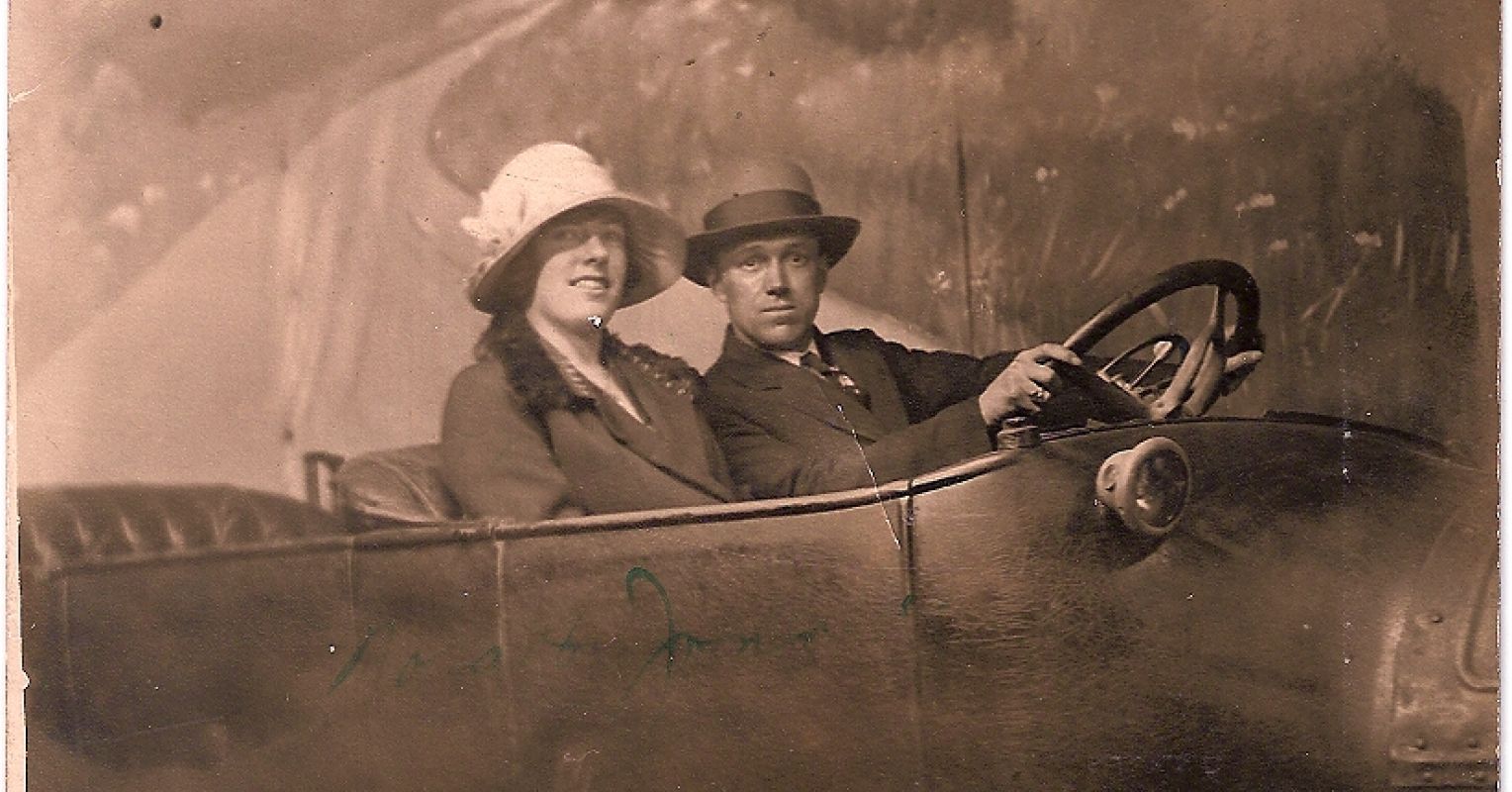
As a college student in the Kodachrome 1970s, I remained connected to that sepia-toned generation through family stories, told by those who had lived it. I was about as close in age to my aunt as she was to my mother, making her a bridge between generations, the keeper of the stories. The eulogy her son delivered at her recent funeral remarked on how many of her conversations had started with “tell the one about…” We could all still hear her saying it.
When her thoughts turned to her dad, my aunt’s go-to story was about a 1918 mustard gas attack, and how my grandfather was never the same after that. (How she deduced that is a mystery, since she was born some 30 years “after that.”) His company was indeed gassed in the Argonne that summer, and she believed her dad deserved a Purple Heart for the injury. His official military records were among millions destroyed in a 1973 fire in a St. Louis warehouse, and without documentation the Army would not award the medal. In true family fashion, my aunt held that grudge for life.
Family Dynamics Essential Reads
I didn’t just learn about the two world wars or the Depression in history classes—my siblings and cousins and I heard about the struggles directly from those who lived through it all. We may not have heard our grandfather’s stories, but we heard variations on them as other relatives repeated them (again and again). We may have rolled our eyes and sighed at the 15th retelling, or the 50th, but we absorbed those stories and they became part of us.
That’s why the recent passing of that little girl, 76 years after she clung to her mother’s hand at her father’s grave, feels so momentous. She was the last one to have heard his stories of the Argonne Forest firsthand, the last of her first-to-be-born-here generation, the last of our family whose baby photos are sepia.
My kids find it hard to believe that my grandfather fought in the first World War (was that before or after the Peloponnesian War?) and my father in the second (wait, like that Iwo Jima?). They are connected to history through me, and through the stories I am now charged with telling them—despite their eye rolls and heavy sighs.
With parents, aunts, and uncles all gone now, I know my generation is next in line, which is a sobering thought. I look to the family stories for history, for guidance on how to take my place in that long narrative, and how to live within it.
Of all the takeaways, though, my greatest hope is that nobody walks away from my grave thinking that it’s the happiest day of their life.

