

970x125
I live across the street from an 80-acre park and spend many mornings walking its paths, especially those in the rose garden, which is a favorite of local photographers. Young families with new babies, adult children with aging parents, graduating seniors—they’re often in the park, creating keepsakes for the family photo wall. But, most importantly, they’re building memories. I am especially taken by the young women getting their senior photos taken, leaning casually against a wall, their hair shining in the sunlight, their dresses shifting in the wind, their toenails painted.
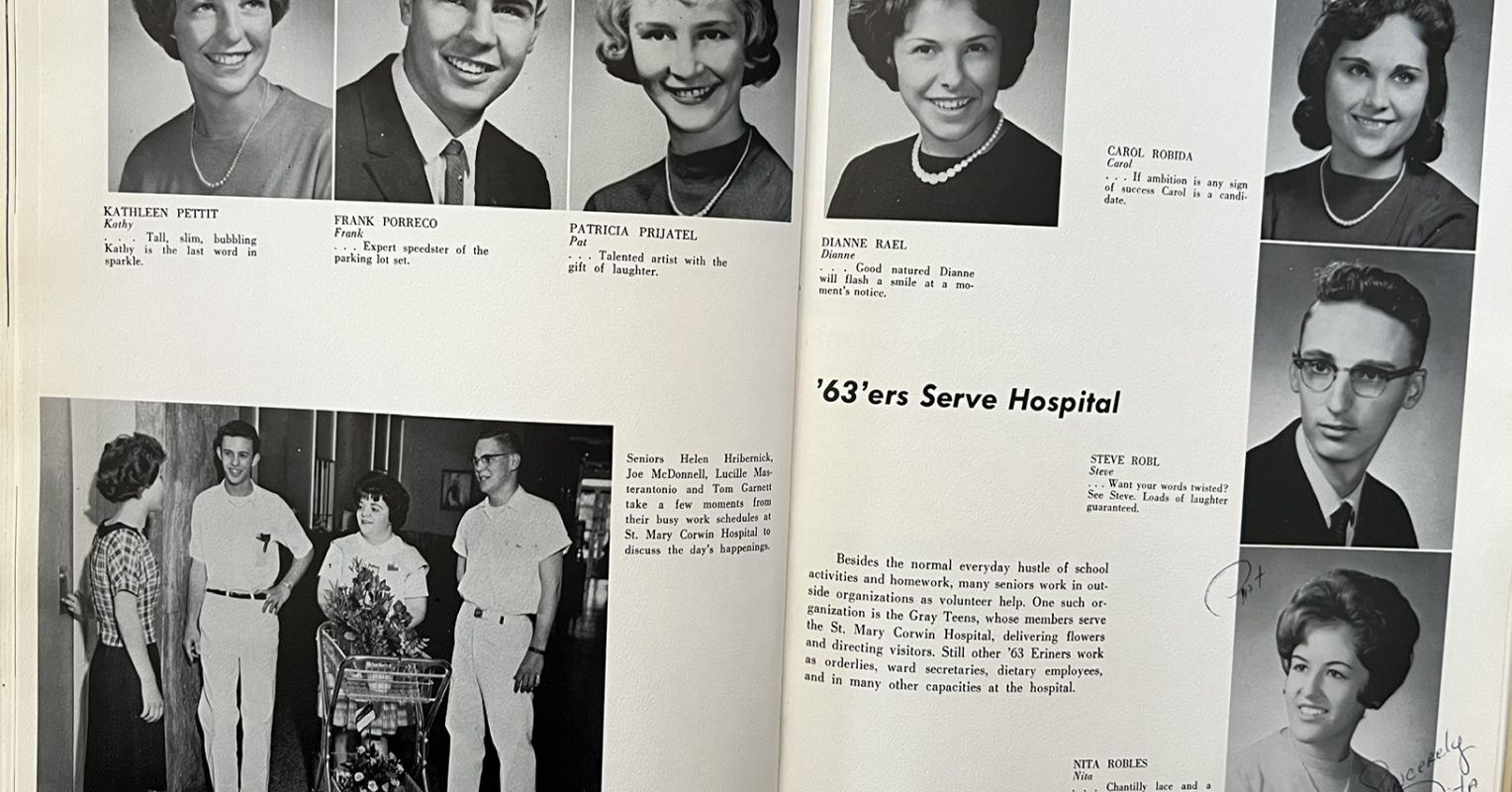
My senior photo was a different story. We had some serious rules back in the 1960s at my Catholic high school. We wore simple sweaters and pearls for a black-and-white studio shot identical to all our classmates. Only the faces changed, although some of us faced left and others faced right. No billowing dresses and flowing tresses like those young women of today.
I don’t remember my photo shoot at all, and I wonder where I got the pearls and sweater because those were not my fashion choices. I do remember walking by the studio weeks after my photo was taken and seeing my picture in the window. Just a black curtain and my face in a frame, artificially colored—my cheeks fake pink, my hair ash blonde. I was such a dumb kid, I just looked briefly and walked by. It never occurred to me to go in and ask why my photo was on display. Or even to ask why it had been painted and if I could have it after it had served its purpose.
What did it mean that I was in the window? Why had the photographer chosen to paint my shot? I had already received the black-and-white prints I had ordered, so what was this about? Should I have been flattered or appalled? I’m not sure. But, for whatever reason, I just walked on.
That fresh-faced kid in the pearls was still highly tentative, not entirely comfortable with herself, uneasy speaking out, and easily embarrassed. She would have been mortified to go into the studio and ask about a photo of her very own self. My heavens, what might the photographer have said?
I didn’t feel safe asking the photographer the simplest of questions: Can I have my photo? Instead, I let it disappear to history, but it remains in my memory. Bottom line, though, is that the photo wasn’t all that important to me.
Maybe it belonged back there, in that time, not tucked in my junk drawer. Because, had I retrieved it, chances are great it would not have survived our many decades of moves.
It can be difficult to understand the importance of our actions as we are in the midst of living with them. Life is just one thing after another, with a lot of stuff, and some of it is worth hanging onto, while much of it should be left to die a natural death.
Why the memory of the colorized photo survives, and others don’t, is a psychological mystery. Why the memory is important, and the photo wasn’t, is also a puzzle. But maybe that’s as it should be. Memories are easier to store. At least for a while.
Many of our friends are now downsizing, as we did six years ago, and it’s intriguing to hear what they’ve saved and are just now giving away or selling. Silver place settings? Apparently, those are worth something now if they’re pure silver. Fancy serving dishes? Those don’t have much value. Original paintings? Other artists might buy them for the canvas, painting a portrait of their cat over your scene of the Adirondacks.
Some things have monetary value, some have meaning, and some have both. The value changes with the vagaries of the economy—nobody wanted silver a few years ago, and now it brings a nice chunk of change.
But meaning is ours to give.
So that photo? Meh. It’s a fun memory, but I don’t need a painted version of my young self. She grew up and learned to speak for herself. That’s the thing I cherish.
I wish the same for those beautiful young women in the park. In fact, I am depending on it.

