

970x125
Director Paul Bunnell reinvents a legendary Lon Chaney film in A Blind Bargain
Paul Bunnell, director of A Blind Bargain, didn’t want to simply “remake” the long lost 1922 Lon Chaney movie of the same name.
He wanted to totally reimagine it — complete with an updated setting of 1970.
“It’s not a remake, but we do use quite a bit of the original story elements,” Bunnell told Wicked Horror. “It being a lost film, we can’t really do a side-by-side comparison.”
The lost Chaney film was an adaptation of the Barry Pain novel “The Octave of Claudius,” first published in 1897.
From the outset, Bunnell said he wanted his film to feel like the classic Rod Serling television series The Night Gallery.
“I considered doing it like a silent film, or something that takes place in the ‘20s or ‘30s,” he said. “But I just really wanted to make the movie, set it in more of a contemporary setting, yet it still takes place in the past.”
Bunnell shares a co-writing credit alongside John Falotico and Bing Bailey.
“I’ve always been a filmmaker who sort’ve likes to delve into the period-type films, or at least a preconceived notion of a period piece,” Bunnell said. “We had to be exact and I’m a stickler for these little details — so I went out and made sure I got the best production designer I could find, a very talented young lady, her name is Frida Oliva.”
Bunnell went to great lengths to ensure the historical authenticity of A Blind Bargain.
“Even the cars that were on the streets, I hand-picked all of those,” he said. “I think if there is one thing I left out that I probably could’ve added was having antennas on the houses — back then, everybody had an aerial because that’s how they watched their TV.”

Meet the cast
Bunnell, whose directorial oeuvre also includes 1994’s That Little Monster and 1986’s Strange Tales, said the shooting schedule for A Blind Bargain wrapped up in 18 days.
“I think that this movie just has an interesting, kind of unique place in my filmmaking catalog because it’s different,” he said. “I think it’s probably the biggest budget I’ve ever worked with and it’s also got the biggest name actor that I’ve ever worked with.”
The antagonist of A Blind Bargain is played by Crispin Glover, a veteran character actor famous (if not infamous) for his roles in films such as Back To The Future, Friday the 13th: The Final Chapter and Willard.
“We had been looking around for a good, kind of a name actor,” Bunnell said. “Sure enough, we got in touch with him and he liked the script.”
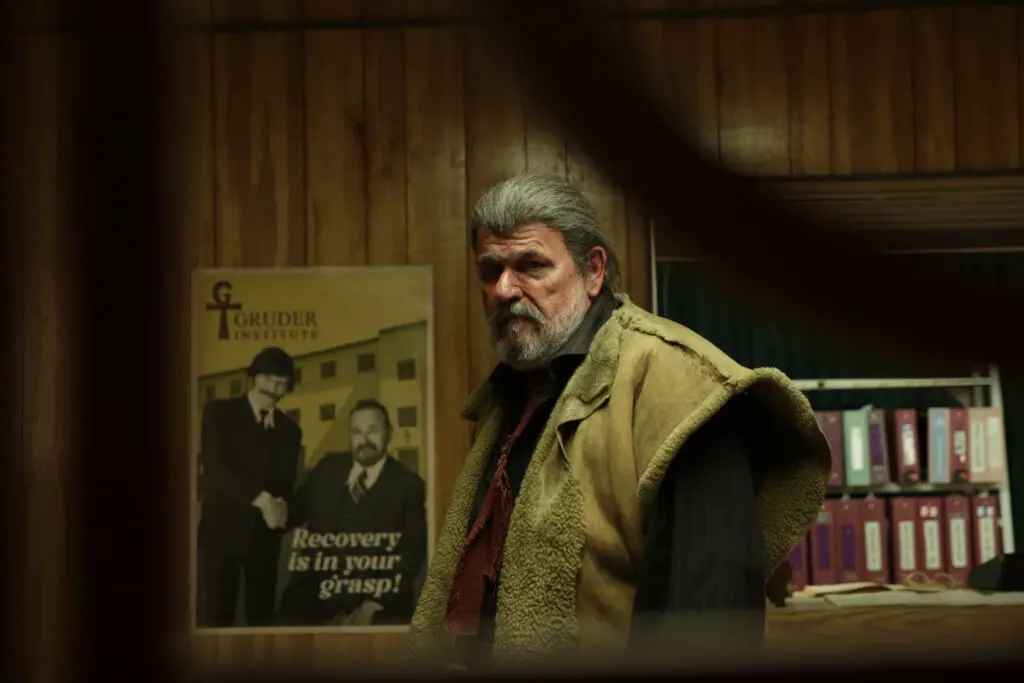
In the film Glover portrays Dr. Gruder, a “morally ambiguous physician” who strikes up a devilish deal with protagonist Dominic Fontaine, played by Jake Horowitz.
“He adds gravitas to this thing that we wouldn’t have had otherwise,” Bunnell said of Glover. “And he just seems perfectly suited for this kind of a film, too.”
Bunnell said Glover was more than just an actor on the set — he was an active participant in shaping the dialogue itself.
“We had a lot of cursing in the script, which I’m not really a big fan of,” Bunnell said. “But he just felt that if you see a period piece and there’s modern day cursing in it, it kind of takes you out of that and I agree with that. We took any severe curse words out and we replaced it with something more creative.”
Also featured in A Blind Bargain is Rob Mayes — perhaps most recognizable from his titular performance in the 2012 Don Coscarelli-helmed John Dies at the End.
“Whenever Rob was on the set, if I was having a stressful day before I knew I was going to have a fun day with Rob,” Bunnell said. “That character of Vincent that he plays was written as a straight, kind of menacing drug lord … the way Rob approached it, it just kind of came out a little funny. I didn’t expect it and it was great, we went with it — I even gave him sort of a weird-looking house, you wouldn’t think this macho guy would have this pink house.”
Other performers in A Blind Bargain include Sean Whalen, Lucy Loken, Annalisa Cochrane and Amy Wright.
Jed Rowen, who worked with Bunnell in 2012’s The Ghastly Love of Johnny X, plays a character in the film named Logos. Bunnell described the role as Igor-like — something that would’ve been right up Chaney’s alley during the heyday of silent cinema.
“All of them are really good,” Bunnell said of the ensemble cast of A Blind Bargain. “My wife was even in the film, believe it or not. She has a small role.”
Getting the look
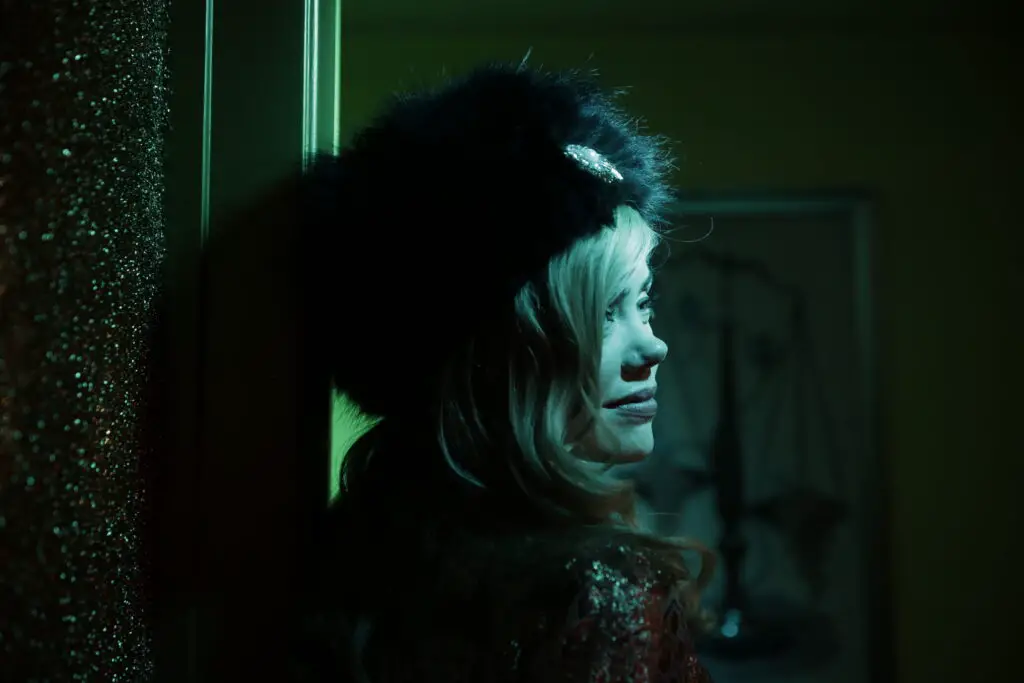
A Blind Bargain was shot on Super 16 film. Francisco Bulgarelli, whose previous credits include 2024’s The Bad Guardian and the series Bring on the Dancing Horses, served as cinematographer.
“I knew that he was up to the job of doing it,” Bunnell said. “I wanted to give it kind of a grainier film look, so that’s why we used the smaller gauge instead of 35mm … I wanted to give the perception that you were watching something from 1970 that might have been on television.”
The film’s colorist was long-time David Lynch collaborator George Koran.
“I specifically requested George, so we worked in the late night hours on his shift to add FotoKem,” Bunnell said. “Boy, he was just wonderful to work with, he had a lot of great stories about David Lynch.”
Bunnell, along with several stars of the new movie, will be present for the opening of A Blind Bargain at New York’s Angelika Film Center on April 24.
“We’ll all be up there, talking about the film,” he said. “We’re also opening up in Los Angeles on May 8, with select shows being in 35mm at Landmark’s NuArt Theater. And we’re going to be playing at the Laemmle theaters, as well, in North Hollywood and Encino.”
He said the film will also play at some Alamo Drafthouse venues in New York and Los Angeles.
“We’re in talks with one of the big theater chains — I don’t know if we’ll get it — but we’re keeping our fingers crossed,” Bunnell said. “And then we’d go more national but for now we’re in select theaters and arthouses and whatnot.”
He said he definitely wants to see A Blind Bargain receive some type of home media physical release.
“We’re in talks right now with a distributor to see who might best serve that,” he said. “And, of course, we’ll put it out on V.O.D. and all of the streaming stuff.”
Something totally different
Bunnell said he wouldn’t necessarily classify A Blind Bargain as a pure horror outing.
“It’s more of a weird tale,” he said. “As far as what people going into it are expecting, I think whatever you expect, you might come out with a slightly different impression of the film.”
Just don’t expect an all-out gore-a-thon here. Bunnell said A Blind Bargain is more of a “think piece” with a tone more along the lines of The Twilight Zone than The Substance.
“It is genre for sure, it is cult, it is quirky,” he added. “People say they don’t expect it to be funny and there is a lot of humor in the film.”
Bunnell said it’s certainly a much different kind of film than what’s currently circulating around America’s multiplexes.
“It’s got an interesting pedigree,” he said. “So people are naturally curious and drawn to it and what you get is a well-told story — it veers off a little into areas you don’t expect. And that’s the fun of it.”

