

970x125
Alright, Caleb Phillips. When your feature debut draws comparisons to Coherence or The Endless, you’re doing something right. The film, titled Imposters, carries a tradition of independent sci-fi-horror cinema impressing audiences with restricted productions. It’s a testament to mood, narrative mobility, and the importance of conceptual intrigue when you don’t opt to rely on more genre-heavy elements. Phillips toys with unknowns and leans into doppelgänger mythology, playing in a Black Mirror sandbox that hits compellingly intrusive notes the farther he pushes his twisted parenthood tale.
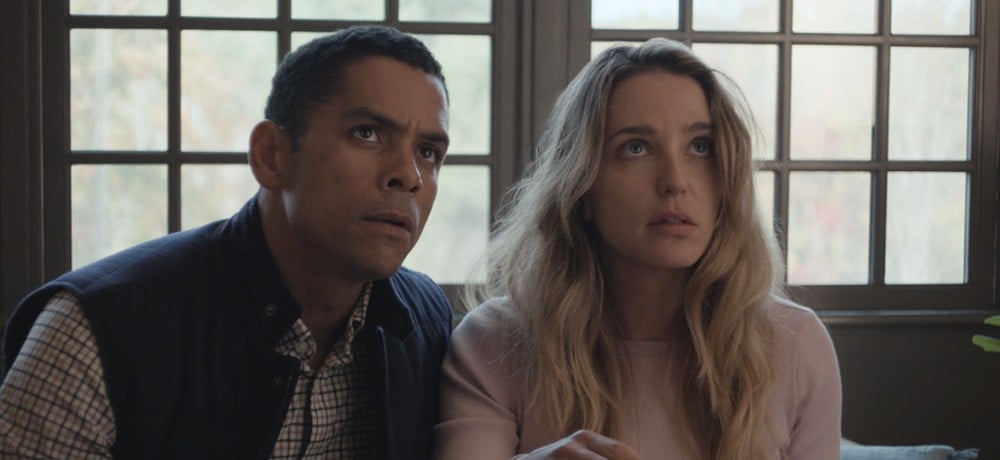
Despite a stereotypical-sounding setup, Imposters is no Lifetime special. Paul (Charlie Barnett) and Marie (Jessica Rothe) ditch bustling cityscapes for a quiet, off-the-beaten-path town where everybody knows your name. Paul’s this cosmic optimist who floats through life flipping coins, because there’s no such thing as choice—everything is the universe’s will. Marie goes along with her husband’s existential jargon, until tragedy strikes. Paul and Marie’s son vanishes right under their noses during a random earthquake. Paul blames local hermit Orson (Bates Wilder), but Orson claims otherwise, handing the couple a crudely drawn map with a cave marked where they can retrieve their son.
What unfolds aligns with paradoxical science fiction thrillers that’ve stolen the spotlight in past years. Films that leave us stimulated, like Plus One or Redux Redux. Phillips’ resources are tight, yet his imagination is expansive. That’s the beauty of a film like Imposters: it’s deceptively simple, with full investment in the story because there’s nowhere for lagginess to hide. These are the types of independent films that are the gutsiest to create, because everything rides on a killer script and anchoring performances.
Consider these pillars fortified in Imposters. Paul and Marie shoulder the lion’s share of screentime, subject not only to the terrifying mystery that leaves their child’s safety in question, but also to their own marital problems, and to how Paul’s suspicious virtuosity paves the way for a conversation about existential morality. As much as Imposters is about a missing infant, it’s more about Paul’s choices and what Marie tolerates, as dictated by their devotion to societal constructs. Phillips ponders everything from butterfly effects and multiverses to consequential livelihoods through Paul and Marie. The disappearance conflict, while important, hides deeper thoughts about existence that burn brighter as tension throttles.
Barnett and Rothe are the glue holding Imposters together, ping-ponging their characters’ unique spirals off one another; one is always on the receiving end of drama. Marie is the paranoid housewife who’ll believe anything that brings her baby home; Paul is a workhorse, distracted by the siren’s call of his past life as a metropolitan police officer. Phillips doesn’t necessarily want you to like Paul, given how he’s written, which can sometimes be difficult for Barnett to wrestle with—but Rothe is there to rein these scenes in. Their dynamic is bottled suffering in favor of picture-perfect appearances, and despite indulging in Paul’s less favorable qualities that drag on, both actors earn deserved praise.
Imposters is proof of Phillips’ sharp talents, primarily in what the writer and director achieve with abstract minimalism. The film’s problems lie in an overstretched length and certain scattered performance choices, though not pervasive. Rothe especially shines as she throws herself to the wolves of Phillips’ catastrophizing screenplay. Where things begin and end play like separate entities, which is an exciting feature. Imposters is this shifty, long-simmering, and substantive mind-teaser that skews into disaster, punched home by one heck of a finale.
Movie Score: 3.5/5

