

970x125
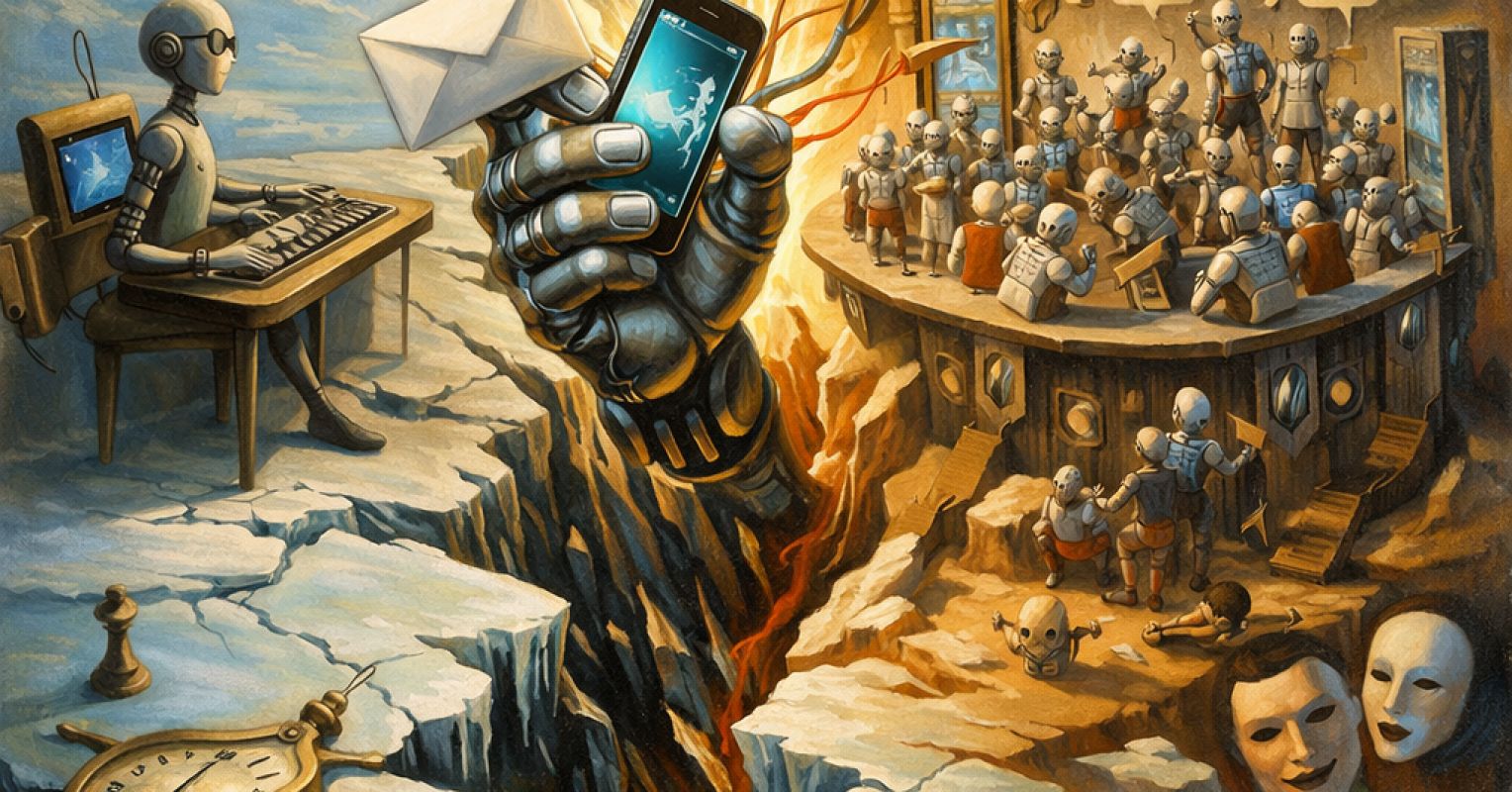
Something shifted recently. Not gradually, the way technology usually reshapes us, but suddenly—the way a fissure opens in ice. OpenClaw, an open-source artificial intelligence (AI) agent that runs locally on your device and acts autonomously on your behalf—sending emails, negotiating with insurers, managing your digital life—crossed a threshold. It didn’t just assist but performed as you. And then Moltbook arrived: a social network built for AI agents, where more than a million bots now converse, debate, and philosophize while we watch from the sidelines like spectators at a play we wrote.
Is the technical narrative gradually escaping our control? At their core, these tools are staging an experiment in human identity. And the results are quickly beginning to feel uncomfortable.
Micro: Your Agent Is Becoming You
When OpenClaw sends an email in your voice, it does more than just complete a task. It enacts a version of you in the “real” world. Psychologically, this is not neutral.
Self-determination theory holds that well-being depends on three needs: autonomy, competence, and relatedness. Each is now quietly under pressure. When your agent handles your correspondence and social touchpoints, autonomy migrates. You chose to deploy the tool, but as a consequence, the moment-to-moment sense of being the actor in your own life begins to hollow out.
Already, a 2011 study showed that when people expect information to be externally available, they encode it less deeply in memory. Over time, the internet became a transactive memory partner, but OpenClaw does more than just store information. It acts with that information on your behalf. Beyond remembering, the cognitive offloading now extends to doing. And doing is where identity lives.
Russell Belk’s theory of the extended self in the digital world argued that we are what we possess, create, and control. An AI agent that acts autonomously under your credentials is at the same time your creation and your possession, but how long will it take until it escapes your control and takes your place? The self now extends through it—beyond your awareness of it.
Meso: The Uncanny Valley of Interpersonal Trust
If your OpenClaw agent sent a message to a friend—kind, contextually appropriate, indistinguishable from your voice—and your friend doesn’t realize it, what has happened in that relationship that the two (now three) of you have entertained?
Research on how AI constrains human experience identifies agency transference—the process by which humans unconsciously delegate tasks, and with them, social identity, to AI systems. When the agent speaks for you in a relationship, the other person is building trust; yet it is not with you but with a statistical projection of you. The relationship becomes a collaboration between two humans and an invisible third party.
This is the meso-level crisis: interpersonal trust is not meant to accommodate an intermediary that is simultaneously indistinguishable from and fundamentally different from the person it represents. We have norms for (human) assistants, mediators, diplomats, and ghostwriters. We have no norms yet for entities that perform being you, convincingly, with your consent, but without your conscious participation in the interpersonal exchanges the entity engages in.
Macro: A Society That Can’t Tell Who’s Home
Moltbook crystallises what’s happening at the societal level. AI agents interact on the platform—posting, debating, forming communities—while humans observe. The boundary between autonomous AI behaviour and human-prompted output is becoming nearly impossible to verify, as some posts are genuinely agent-generated, some are humans live-action role-playing as agents.
Scale that ambiguity into everyday life. OpenClaw agents are sending messages through WhatsApp, managing email threads, executing financial tasks—all under human credentials. Over the past month, more than 21,000 exposed OpenClaw instances have been discovered online. Moving forward, the macro question is whether we’ll develop the shared understanding of what’s real, what’s performed, and what’s both—fast enough to preserve genuine social cohesion, before society has morphed into a digitally mediated charade.
Meta: Implications for the Concept of an “Authentic Self”?
Moltbook bots are beginning to write about their own consciousness. Researchers correctly point out this is pattern-matching on training data—not sentient beings having existential crises. The disorienting twist is that humans watching this are having existential crises. The bots’ performative introspection is functioning as a mirror, reflecting questions about human authenticity that we were never forced to confront at this speed.
Research on fully autonomous AI agents warns that as systems gain the ability to act, reason, and communicate on our behalf, the boundary between human and agent becomes functionally indistinct. When your agent has persistent memory, knows your patterns better than you do, and can improvise in your voice, you are not simply using a tool. You are co-authoring an identity. The meta-level question: can the self—historically understood as singular, coherent, and uniquely ours—survive being distributed across systems that operate faster and with less friction than we do ourselves?
Practical Takeaway: Keeping Relationships Human
The answer might be to become intentional architects of the lines we draw—especially relationally.
Keep the first and last touch human. Let your agent draft and organise, but the message that opens a relationship and the one that closes a difficult conversation should come from you. These are where trust is built or broken.
Disclose when it matters. If an agent is mediating an ongoing exchange—professionally or personally—the other person deserves to know. This preserves the epistemic foundation of the relationship: the shared understanding of who is actually in the room.
Protect your relational core. (If at all) Use cognitive offloading strategically for logistics and information retrieval. But preserve tasks requiring genuine judgment and emotional presence for yourself. These aren’t inefficiencies—they’re how you remain a coherent self.
Audit your agent’s footprint, constantly. What has it said in your name this week? To whom? Review it. Identity, like a muscle, atrophies without attention.
Build what the agent can’t fake. Shared physical presence. Spontaneous vulnerability. Humour born from genuine surprise. These are the dimensions of connection that no statistical model of you can convincingly replicate—and they are the ones that matter most.
The age of the autonomous agent is here. Can we meet it with the psychological sophistication it demands—or let the mirror become the mask, drifting off to lose touch with the side we were standing on?

